

“Working with Michael over the past nine years has been transformative. His ability to elevate my strategic thinking and sharpen my IT vision has directly influenced how we align technology with business goals.” — Todd, CIO for a manufacturer
Why Most Diagnostics Don't Move the Needle
The problem isn't the findings. It's the list.
In professional cycling's team pursuit event where four cyclists ride in an indoor track, the team's finishing time is determined by the last rider to cross the line - not the fastest. It doesn't matter how strong your lead rider is. The team's result is set by the slowest.
Most organizational assessments work against this principle. They identify every gap, score every dimension, and hand you a list of improvements ranked by severity or frequency. The problem isn't that the findings are wrong. It's that improving your strongest areas while the real constraint remains untouched produces marginal gains at best - and more work for an already stretched team.
The CxO Amplify Keystone Method works differently. My diagnostics identify the few number of factors most limiting your progress - the "slowest riders" in your system - and sequences everything else from there. Fix those first, and the return on everything else you've already built compounds automatically.
That's not a philosophy. It's how constrained systems actually work.
The Diagnostic Suite
The right diagnostic for where you are right now.
Four diagnostics. Each one built on the CxO Amplify Keystone Method. Each one designed for a different organizational challenge.
The diagnostics in our suite are built on the same principle. Rather than scoring your organization across dozens of dimensions and handing you a prioritized to-do list, each one identifies the factor most limiting your progress - and the specific actions that will produce the greatest impact. That's the Keystone finding. Everything else sequences from there.
Not sure which diagnostic fits your situation? We identify that together in the first conversation.
Quick Nav: AI Readiness | Initiative Success | Technology Leverage | Cyber Risk Ownership
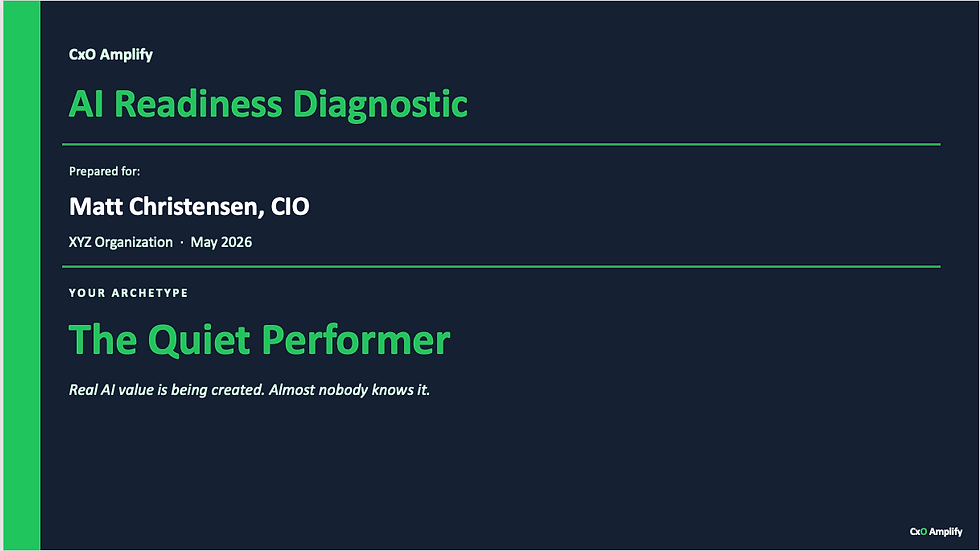
Most AI strategies treat readiness as a single question. This diagnostic recognizes that your organization faces five fundamentally different types of AI - Assistive, Embedded, Process, Analytical, and Autonomous - each with different value, risk, governance, and investment implications. You receive a detailed readiness assessment across all five types, your archetype from five distinct profiles, and a prioritized path forward. Built for CIOs who need to move past the hype and make defensible decisions.
AI Readiness Diagnostic
Everyone is under pressure to move on AI. The harder question is what your organization is actually ready to scale - and where the real gaps are.

This pre-launch diagnostic identifies the hidden organizational conditions most likely to derail your next major initiative before it gets off the ground. Rather than assessing the initiative itself, it surfaces the underlying factors - cultural, structural, political - that determine whether even a well-designed initiative will succeed. Run this before you commit resources, not after.
Initiative Success Diagnostic
Most major initiatives don't fail during execution. They fail before they launch.


Technology Leverage Diagnostic
Your IT organization is delivering. But is it delivering the right things - and does leadership know it?
Using the CxO Amplify Keystone Method across CxO Amplify's 12 operating model components, this diagnostic identifies the factor most limiting your organization's IT performance. You receive a detailed report with your archetype from seven distinct profiles, a full findings analysis across four dimensions, and a sequenced action plan. Most clients say the findings feel uncomfortably accurate - because they're drawn from patterns observed across hundreds of IT organizations.


Cyber Risk Ownership Diagnostic
Cyber risk is everyone's problem and no one's responsibility. That gap is where breaches live.
This diagnostic clarifies accountability, escalation, and executive ownership of enterprise cyber risk across your leadership team. It surfaces where responsibility is unclear, undeclared, or dangerously fragmented - and provides a framework for closing those gaps before they become incidents.
In Development - Available Soon

Not sure which diagnostic fits
That's exactly what the first conversation is for. We'll look at where you are, what's generating the most friction, and identify which diagnostic - or which combination - maps most directly to your situation.
There's no pitch. Just a conversation.
"Michael often said that everything I do should be able to be explained in terms of making money, saving money, or managing risk - and this will forever be top of mind in all my planning and strategy meetings. He is great at tying IT outcomes to business value."

CLINT, CIO, Healthcare Products Manufacturer


